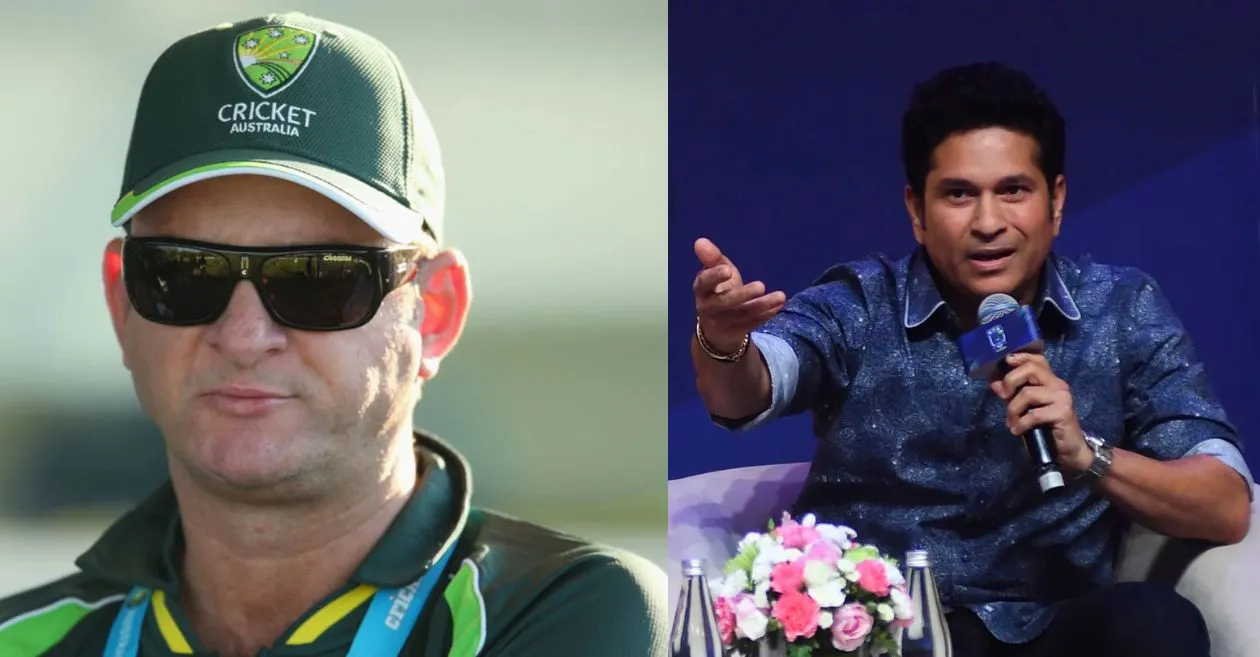

The debate over the greatest cricketers to ever grace the long-form game is an eternal one, often fueled by personal bias, era-specific dominance, and statistical milestones. However, eyebrows were raised across the cricketing world recently when Australia legend Mark Waugh unveiled his personal all-time Test XI. While the list is predictably stacked with icons of the sport, it is the absence of Sachin Tendulkar—the highest run-scorer in Test history—that has sparked intense discussion among fans and pundits alike.
Waugh, known for his elegant batting and sharp slip catching, chose a lineup that prioritizes aggressive intent and sheer match-winning capability over pure statistical accumulation. By omitting Tendulkar, Waugh has stepped away from the conventional template of dream teams, opting instead for a middle order that favours flair and raw intimidation.
Sachin Tendulkar left out as Mark Waugh unveils his greatest Test XI
Waugh’s opening pair sets a tone of relentless pressure. He opted for his former teammate Matthew Hayden, whose brute force redefined opening in the early 2000s, alongside England’s Graham Gooch, a master of longevity and technical prowess. This combination offers a blend of left-hand/right-hand dynamics designed to unsettle any bowling attack from the first delivery.
The middle order is where Waugh’s personal philosophy becomes most evident. At number three is Brian Lara, the only man to score 400 in a Test innings, followed by Waugh himself (humbly, or perhaps strategically, slotting into his preferred position) replacing Sachin. The inclusion of Sir Vivian Richards at number five ensures a “swagger” factor that few teams could match. To provide balance, Waugh selected Jacques Kallis as the genuine all-rounder. Kallis, often cited as the most complete player in history, provides the luxury of a fifth frontline bowling option without sacrificing batting depth.
The bowling department is equally terrifying. Waugh went with the wizardry of Shane Warne as the sole specialist spinner, backed by a pace trio of Wasim Akram, Curtly Ambrose, and Glenn McGrath. This attack covers every conceivable base: Akram’s swing and pace, Ambrose’s bounce and accuracy, and McGrath’s metronomic persistence.
The Tendulkar snub and David Lloyd’s playful jab
The exclusion of Tendulkar is particularly jarring given his 15,921 Test runs and 51 centuries. In the wake of this revelation, the social media discourse turned toward the competitive rivalry between the Australians and the Indians during the 90s and 2000s. While Waugh’s list is subjective, many argue that a Test XI without the man who carried the expectations of a billion people for two decades feels incomplete.
Adding a layer of British humor to the controversy, former England coach and commentator David Lloyd reacted to the news in his characteristic style. Known for his wit, Lloyd jokingly “rang up” Tendulkar in a mocking fashion during a broadcast segment of “Stick to Cricket”, teasing the Indian legend about his unemployment from Waugh’s fantasy team.
Lloyd’s lighthearted mockery served to highlight just how synonymous Tendulkar is with the Greatest of All Time conversation. While Waugh’s XI is a formidable collection of talent that reflects his own experiences on the field, the omission of Tendulkar ensures that this particular dream team will remain one of the most debated lineups in recent memory.
Mark Waugh’s best Test XI
Mathew Hayden, Graham Gooch, Brian Lara, Mark Waugh, Sir Vivian Richards, Jaques Kallis, Shane Warne, Wasim Akram, Curtly Ambrose, Glenn Mcgrath
Also WATCH: Arshdeep Singh sends Henry Nicholls packing with a peach in 3rd ODI
For latest cricket news & updates, visit CricketTimes.com.