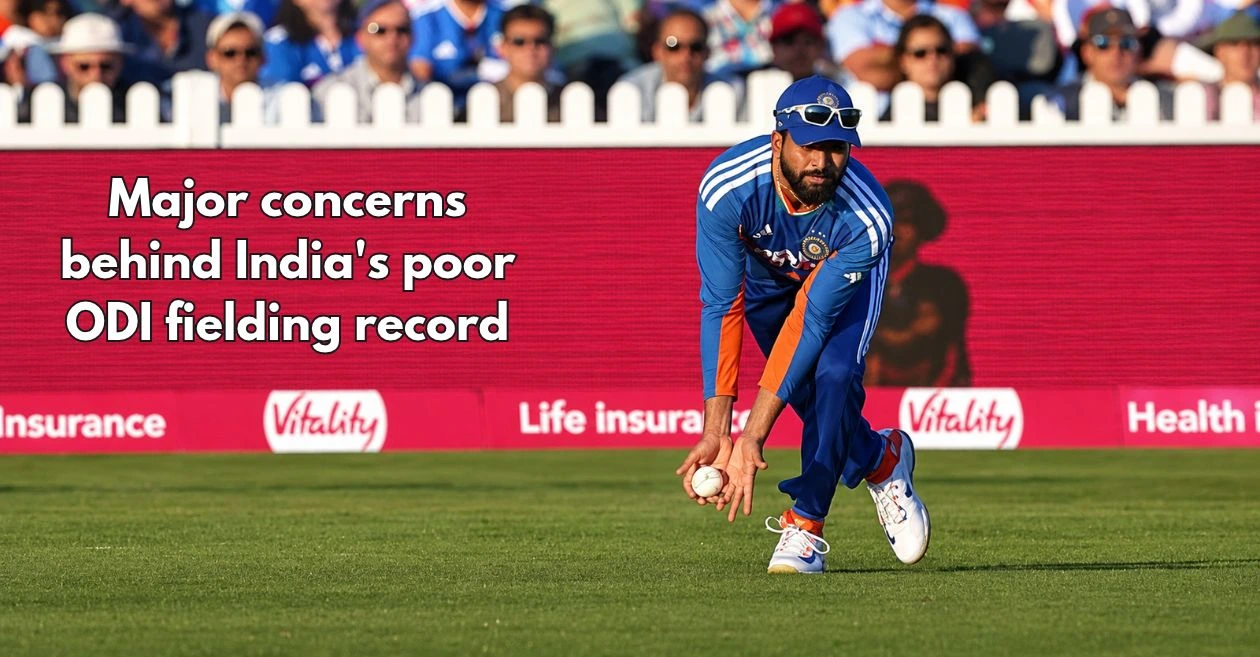

Team India‘s fielding standards have become a growing concern following a string of disappointing performances in international arena, especially ODI cricket. While the team has continued to deliver impressive results with the bat and ball, its struggles to hold on to catches and prevent opposition batters from collecting easy runs have exposed a significant weakness. The latest statistics paint a worrying picture, with India positioned near the bottom among ICC Full Member nations in catching efficiency since 2025.
According to the available data, India have recorded a catching efficiency of just 74.8 per cent across 30 matches. The team has taken 158 catches while putting down 53 opportunities during this period. Among the 12 Full Member nations, only West Indies have registered a poorer catching efficiency.
The recently concluded ODI series against New Zealand offered another reminder of these shortcomings. India dropped nine catches and committed 16 misfields during the series, managing a catching efficiency of only 75 per cent. The hosts performed better across the major fielding parameters.
The fourth ODI was particularly disappointing, as Will Young made India pay for two early reprieves by producing a match-winning knock of 125. Several established players as well as younger members of the squad, came under scrutiny for their fielding efforts. With these problems becoming increasingly difficult to ignore, let’s take a look at some reasons behind India’s alarming decline in ODI fielding standards.
3 factors behind India’s struggles in ODI fielding
1. Repeated lapses in concentration are costing India
One of the biggest reasons behind India’s declining fielding standards is the inability to maintain concentration throughout an innings. Fielding in ODI cricket demands constant alertness, as a single lapse can change the course of a match. Players must remain focused even when they are not directly involved in the action, particularly during lengthy partnerships when opportunities can arrive unexpectedly.
However, India’s recent performances suggest that the team has struggled to maintain that level of consistency. The 53 dropped catches across 30 matches since 2025 highlight the extent of the problem.
The New Zealand series provided a particularly concerning example. India put down nine catches, allowing the opposition batters to survive crucial moments and build their innings. The fourth ODI proved especially costly, with Young benefiting from two early reprieves before going on to score 125.
Such incidents underline how expensive a momentary loss of concentration can become in the 50-over format. Against quality opposition, missed opportunities often translate into additional runs, longer partnerships and increased pressure on the bowling attack.
2. Fielding mistakes are no longer limited to inexperienced players
Another major concern for India is that their fielding problems have affected players across different experience levels. Experienced campaigners are generally expected to set high standards on the field and provide stability to the team. However, recent performances have shown that even established Indian stars have struggled to convert opportunities consistently.
During the New Zealand series, names such as Virat Kohli, Rohit Sharma and Shubman Gill came under scrutiny for fielding lapses. At the same time, younger players, including Yash Thakur, also found themselves under the spotlight. This suggests that India’s struggles are not restricted to a particular group of players but reflect a wider inconsistency within the fielding unit.
The statistics further reinforce this concern. Apart from the 53 dropped catches, India have also recorded 150 misfields in 30 matches. These errors can appear relatively minor individually, but their cumulative impact can be significant. Every misfield offers the opposition an opportunity to rotate the strike, turn singles into doubles or maintain momentum. When combined with dropped catches, such mistakes put additional pressure on the bowling unit and make it harder for India to control the scoring rate.
3. Fielding overhaul fails to produce consistent results
India’s continued struggles in the fielding department also raise questions about the progress of their efforts to improve standards. The introduction of a new fielding coach was expected to bring greater discipline, sharper reflexes and improved consistency to the setup. However, the latest performances indicate that there is still considerable work to be done.
Improving fielding standards at the international level requires more than occasional training sessions. Players need regular practice in different match situations, better communication and the ability to execute their skills under pressure. India’s catching efficiency of 74.8 per cent since 2025 suggests that these improvements have not yet translated into consistent results on the field. Their position among the lower-ranked Full Member nations is particularly concerning for a team with ambitions of dominating international cricket.
The New Zealand series has further highlighted the gap between India’s expectations and actual performances. Dropping nine catches and committing 16 misfields in a single series is not a record the team would want to repeat. India certainly have the individual talent and resources to become a much stronger fielding unit. However, the challenge now is to turn that potential into consistent performances.
With important international assignments ahead, improving their catching efficiency and reducing unnecessary runs will be essential. India’s batting and bowling might continue to win matches, but their fielding standards need an urgent improvement to ensure that avoidable mistakes do not undermine the team’s overall performance.
Team-wise ODI fielding statistics since 2025 (Full Members)
| Team | Matches | Catches | Drops | Catch Efficiency (%) | Misfields |
|---|---|---|---|---|---|
| Ireland | 15 | 77 | 13 | 85.5 | 74 |
| South Africa | 23 | 114 | 22 | 83.8 | 98 |
| New Zealand | 35 | 225 | 45 | 83.3 | 166 |
| Pakistan | 28 | 129 | 29 | 81.6 | 120 |
| Australia | 25 | 136 | 32 | 80.9 | 109 |
| England | 30 | 160 | 44 | 78.4 | 131 |
| Bangladesh | 25 | 131 | 36 | 78.4 | 123 |
| Zimbabwe | 14 | 76 | 22 | 77.5 | 87 |
| Sri Lanka | 25 | 100 | 31 | 76.3 | 97 |
| Afghanistan | 16 | 73 | 23 | 76.0 | 101 |
| India | 30 | 158 | 53 | 74.8 | 150 |
| West Indies | 23 | 100 | 44 | 69.4 | 109 |
Also WATCH: Virat Kohli gifts signed jersey to Matt Henry after historic spell in NZ vs IND 4th ODI
For latest cricket news & updates, visit CricketTimes.com.